Types of Variants in Genomics
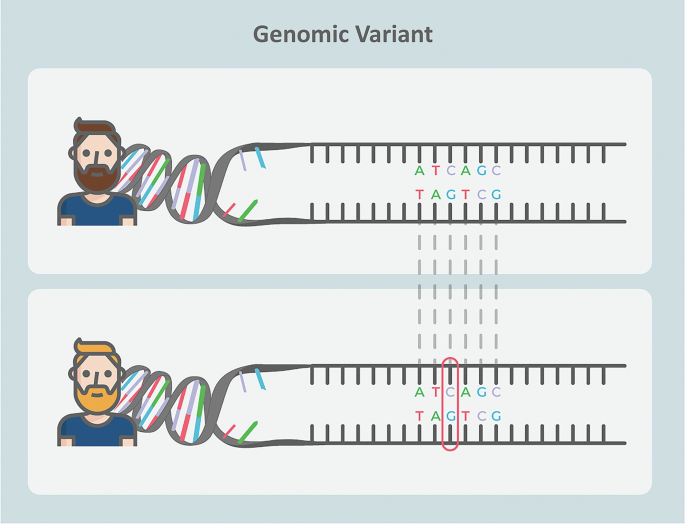
Genomic variants refer to differences in the DNA sequence between individuals of a species. Variants can be classified into different categories based on their size, type, and impact on genes and proteins. These DNA changments may be in singleton on in a differences set.
1. Single Nucleotide Variants (SNVs)
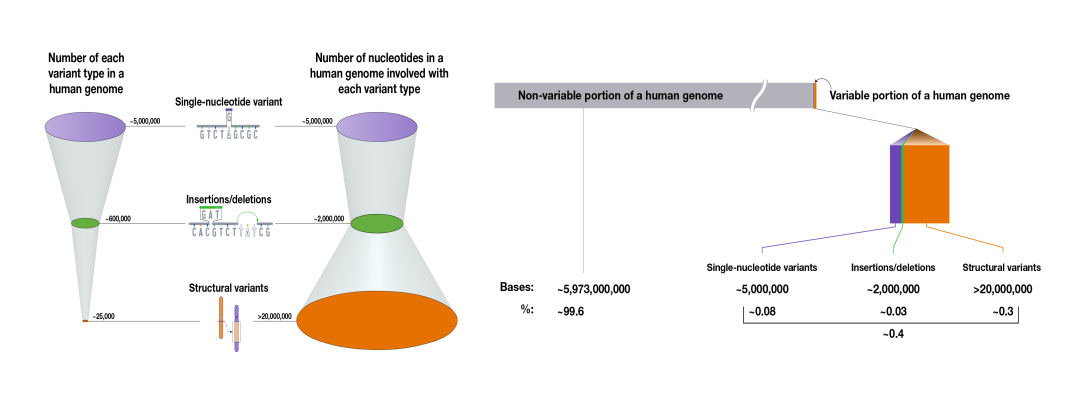
SNVs are the most common type of variant and involve a change of a single nucleotide (A, T, C, or G) in the DNA sequence.
- Types:
- Synonymous SNVs: Change the DNA sequence but do not affect the amino acid sequence of the protein.
- Non-synonymous SNVs: Change the DNA sequence and result in an altered amino acid in the protein. These can be:
- Missense: A single amino acid change.
- Nonsense: Results in a premature stop codon, potentially truncating the protein.
2. Insertions and Deletions (Indels)
Indels involve the insertion or deletion of small DNA sequences.
- Insertion: Addition of one or more nucleotides into the DNA sequence.
- Deletion: Removal of one or more nucleotides from the sequence.
- Frameshift: If the number of inserted or deleted nucleotides is not divisible by three, it causes a shift in the reading frame, often leading to a completely different and usually non-functional protein.
3. Structural Variants (SVs)
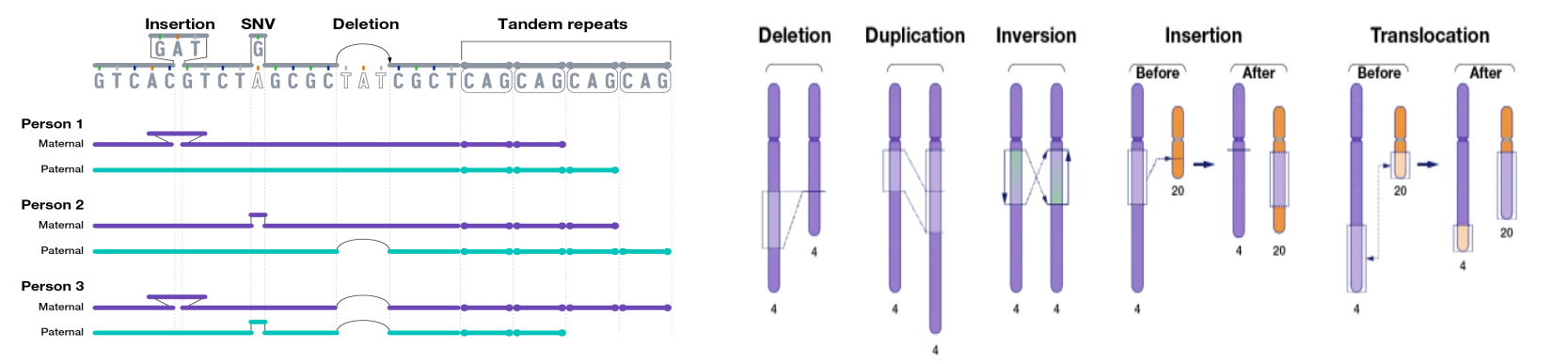
Structural variants refer to larger changes in the genome, typically affecting more than 50 base pairs. These can involve duplications, deletions, inversions, or translocations of large segments of DNA.
- Types:
- Copy Number Variations (CNVs): Large regions of the genome are duplicated or deleted.
- Inversions: A segment of the chromosome is reversed.
- Translocations: A segment of one chromosome is transferred to another.
4. Tandem Repeats
These are short sequences of DNA that are repeated multiple times in a row.
- Types:
- Short Tandem Repeats (STRs): Typically 2-6 base pairs in length.
- Variable Number Tandem Repeats (VNTRs): Larger repetitive regions.
5. Copy Number Variations (CNVs)
CNVs involve changes in the number of copies of a particular region of the genome. These can be large deletions or duplications and can affect gene dosage, potentially leading to disease.
6. Mobile Element Insertions
Mobile elements (like transposons) can insert themselves into different locations within the genome. These insertions can disrupt normal gene function or regulation.
- Types:
- LINEs: Long interspersed nuclear elements.
- SINEs: Short interspersed nuclear elements.
7. Mitochondrial Variants
Mitochondrial variants occur in the mitochondrial DNA and can affect cellular energy production.